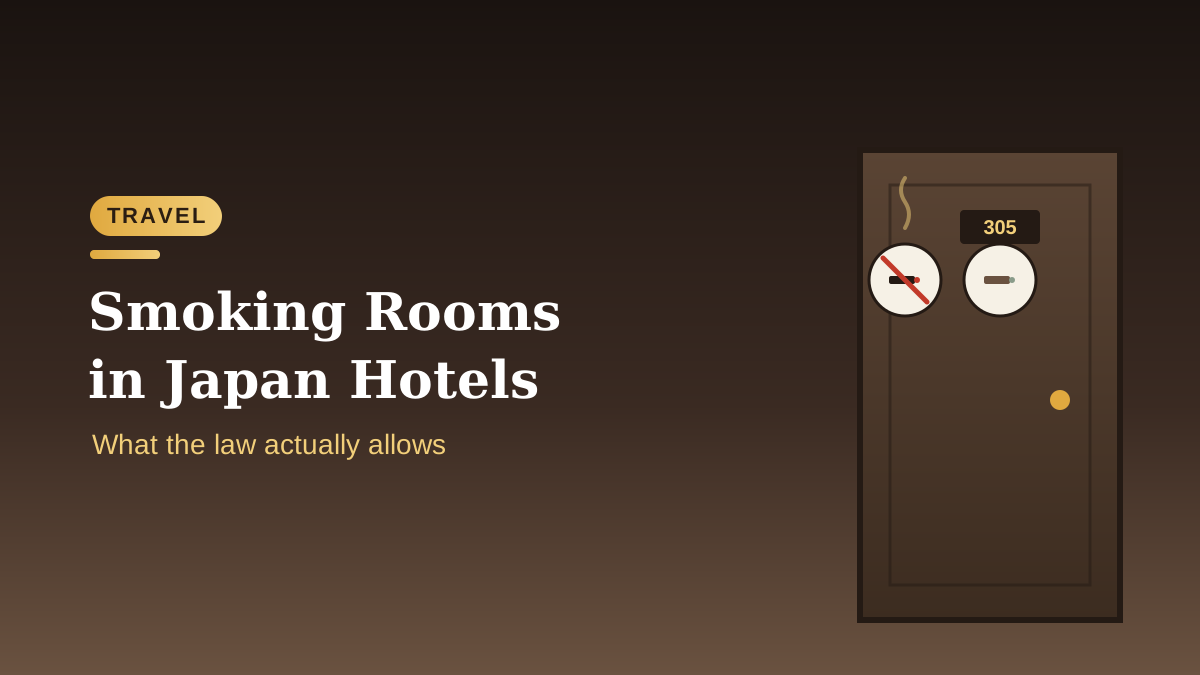
If you've booked a "non-smoking" room in Japan and still worried about it, you're not being paranoid. Unlike most countries we get asked about, Japan's indoor smoking ban has a built-in exception for one specific place: the hotel guest room you're about to sleep in. Here's what the law actually allows, which chains still sell smoking rooms, and how to make sure you end up in the kind of room you actually asked for.
Yes, some hotel rooms in Japan still allow smoking — here's why
Japan's revised Health Promotion Act took full effect on April 1, 2020, and it did make indoor smoking the exception rather than the rule almost everywhere that serves the public: restaurants, bars, offices, train stations. But the law treats a paid hotel or ryokan guest room differently from a restaurant table, because you're renting it as a private space for the night, not sharing it with other customers. Japan's National Consumer Affairs Center spells this out directly in its own consumer FAQ: hotel guest rooms are exempt from the regulation, which is exactly why hotels can legally offer both smoking rooms and non-smoking rooms side by side.
So the shared parts of a hotel — lobby, restaurant, corridors, elevators, the communal bath if there is one — have to be non-smoking in principle, same as everywhere else covered by the law. What happens behind your own door is left to the hotel to decide, room by room.
Which hotels actually still sell smoking rooms
There's no single national answer, because every property makes its own call. In practice:
- Large domestic business hotel chains — Toyoko Inn, APA, and similar budget-to-midrange chains common across Japan — still list both smoking and non-smoking rooms as separate room types on their own booking sites. Toyoko Inn's own reservation page, for example, has a "smoking/non-smoking" filter right on the room search screen, the same way you'd filter by bed type.
- International chain hotels (Hilton, Marriott-family brands, Hyatt, and similar) lean further toward non-smoking, but it isn't a guaranteed global rule the way it is in North America. Marriott's own smoke-free policy statement is explicit that outside the US and Canada, individual international properties can still accommodate local smoking preferences, so a Marriott-brand hotel in Osaka isn't automatically smoke-free just because the chain is.
- Newer "lifestyle" and design-forward hotel brands, which tend to market themselves on air quality and modern fit-out, are the ones most likely to be fully non-smoking building-wide.
Within the same chain, this can vary property to property, even city to city — one Toyoko Inn might have a full smoking floor, and another might have phased smoking rooms out entirely as older inventory gets renovated. You genuinely cannot assume from the brand name alone.
A quiet local habit that explains the logic
We saw a smaller version of this split long before we ever thought about hotel bookings. One of the izakaya we go back to on Miyakojima seats about sixty people, and the dining room is non-smoking across every one of those seats — except a single outdoor terrace table, which exists specifically for anyone who wants to light up. Clean shared air inside, a contained space set aside outside: that's the exact same logic Japan's law applies to hotels, just moved from a terrace table to a guest room door instead of a dining room. Once you see it in a restaurant, the hotel rule stops feeling like a loophole and starts feeling like the same national habit, scaled up.
How to actually get (or avoid) a smoking room
The room-type label is the only thing that matters, and it has to be an active choice, not an assumption:
- Check the room type name at booking, not just the overall hotel rating. "Smoking," "non-smoking," and occasionally "deodorized" or "clean air" are the terms to look for on the room selection screen, both on a hotel's own site and on booking platforms.
- Use the smoking filter on booking sites. Major booking platforms let you filter search results to non-smoking only; it's worth turning on even if you think you don't need to, since some properties default-display their cheapest available room type first regardless of smoking status.
- Book directly with the hotel if the online listing is ambiguous. Most Japanese hotel sites answer a direct message quickly, and it's a faster fix than discovering the room type at check-in.
- At check-in, say the word out loud. If you specifically need non-smoking (or specifically want smoking, since availability for that is shrinking), confirm it verbally when you hand over your reservation — front desks will usually swap you if something's available and the mismatch was genuinely a booking-site error.
The complaint nobody warns you about: a "non-smoking" room that still smells
This is the part that catches a lot of visitors off guard, and it's not something we're making up to scare you — it's a recurring theme on traveler forums. A long-running FlyerTalk thread on Japan hotels is literally titled "non-smoking hotel rooms not guaranteed", and the pattern described there (and echoed across other travel forums) is consistent: some older properties converted a former smoking room to non-smoking on paper without fully clearing years of absorbed odor out of the carpet and curtains, so the room gets listed as non-smoking but still carries a faint smell.
If that happens to you, the fix is the same anywhere: say so at the front desk right away rather than after you've unpacked, and ask directly whether another non-smoking room is available on a different floor. Newer buildings and recently renovated chains run into this far less than older, smaller properties, so if a lingering smell is a dealbreaker for you, it's worth weighting that into which business hotel chain you pick, not just which city.
Smoking rooms by hotel type, at a glance
| Hotel type | Smoking rooms still common? | What to check before booking |
|---|---|---|
| Large domestic business hotel chains (Toyoko Inn, APA, etc.) | Yes, as a distinct room type at many properties | Use the smoking/non-smoking filter on the room search screen |
| International chain hotels (Hilton, Marriott family, Hyatt) | Varies by property, not guaranteed smoke-free outside North America | Check the specific property's room types, not just the brand |
| Newer design/lifestyle hotel brands | Rare | Usually fully non-smoking building-wide, but confirm if it matters to you |
| Capsule hotels | No — smoking areas, if any, are separate common-area lounges, not the pods | None needed for the pod itself |
| Ryokan | Varies, often one or two designated rooms only | Ask directly when booking; availability is limited |
FAQ
Can I smoke on my hotel balcony if my room is non-smoking?
No, assume not. A room is classified smoking or non-smoking as a whole, balcony included, and hotels can charge a substantial cleaning fee if you smoke in a room or on a balcony designated non-smoking. Treat the room type as covering the entire space you were given, not just the interior.
Are hotel lobbies and restaurants in Japan smoke-free now?
Yes, in principle, since the Health Promotion Act took full effect in April 2020. Shared indoor spaces — lobby, restaurant, corridors — are covered by the same non-smoking default as other public-facing businesses. The exception is specifically the guest room itself.
Is it easy to find a guaranteed smoke-free hotel in Japan?
Easier than it used to be, but not automatic. Filter for non-smoking rooms specifically when you book rather than trusting the brand or star rating, and if the smell of a previously-smoking room matters to you, newer or recently renovated properties are a safer bet than older budget chains.
Once your room type is settled, the rest of check-in in Japan has its own small surprises — our guides to passport checks at check-in and how small a "standard" room actually is cover what else to expect before you arrive.