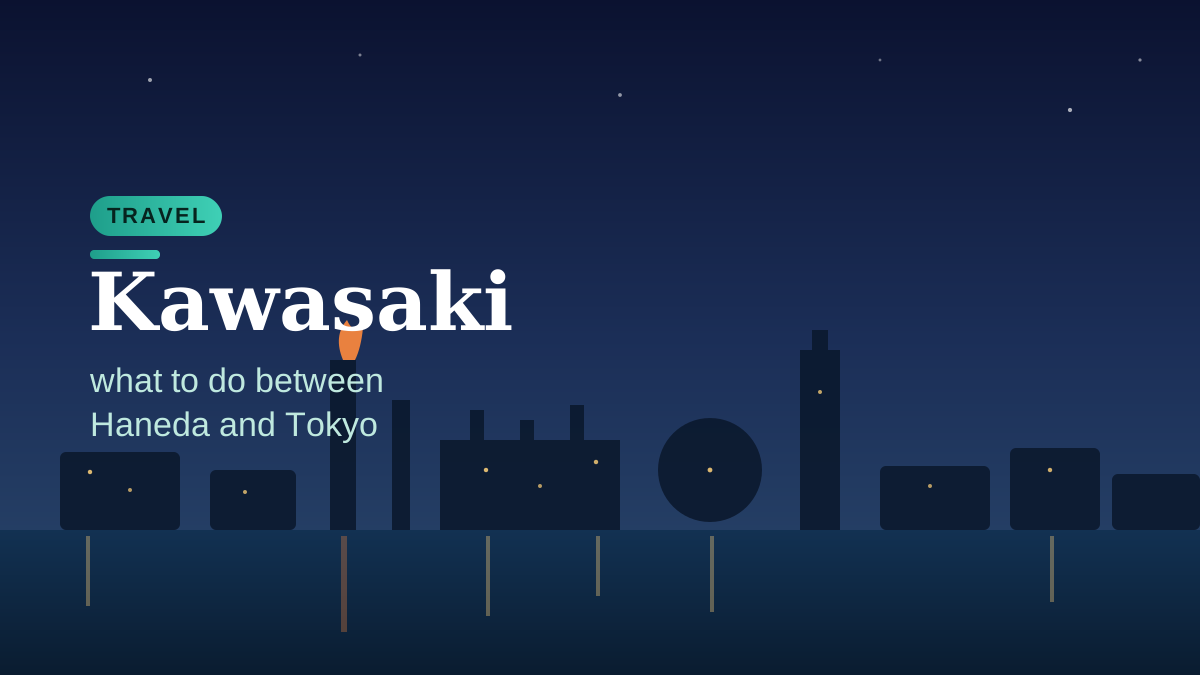
Kawasaki sits right between Haneda Airport and central Tokyo, and almost every visitor rides straight through it without looking up. That's a small waste. This is our home turf — we live in the Kawasaki area and cover its food and streets on the Japanese side of this blog — so here's the honest version: three things genuinely worth stopping for (Doraemon's museum, a thousand-year-old temple, and Japan's most photographed factory night view), how to reach each one, what they cost as of September 2026, and how to slot one into the gap between your flight and your Tokyo hotel.
Why break the trip in Kawasaki at all
Location is the whole argument. Kawasaki is one stop on the Keikyu Line from Haneda Airport — usually 10 to 15 minutes — and another 10 to 20 minutes on to Shinagawa, Tokyo Station or Yokohama. So it's the natural place to kill a few hours if you land in the morning and can't check in until three, or if you have a late-night flight and want somewhere calm to spend the afternoon near the airport.
It is not a "sightseeing city" in the postcard sense, and we won't pretend otherwise. There's no old castle and no famous view from the station. What it has instead is a handful of specific, well-connected spots that most first-time visitors don't know are here — and far smaller crowds than the equivalent in Tokyo.
One quick myth to clear up: for years, travel blogs sent people to the "Warehouse Kawasaki" arcade, a five-storey building styled after Hong Kong's old Kowloon Walled City. It closed permanently in November 2019. If you find it in an older guide, skip it — the building is gone, and there's nothing to visit.
Doraemon's home: the Fujiko F. Fujio Museum
If you travel with kids — or grew up on Doraemon, Perman or any of Fujiko F. Fujio's manga yourself — this is the one to build an afternoon around. The museum is dedicated to the artist and his characters: original drawings, a recreation of his studio, a rooftop play space with life-size figures, and a café that serves food shaped like things from the comics. It's gentle, well-made, and not overwhelming — you can see it comfortably in two hours.
The catch, and the single most important thing in this whole article: you cannot buy tickets at the door. Admission is date- and time-slotted, and every ticket is sold in advance. Tickets go on sale on the 30th of each month for the month after next, and popular weekend slots sell out. Overseas visitors buy through Lawson convenience-store machines (the "Loppi" terminals, which have an English mode) or via the official site. Plan this one before you fly, not on the day.
As of September 2026, admission is ¥1,000 (about US$6.80) for adults and university students, ¥700 for ages 13–17, ¥500 for ages 4–12, and free for children 3 and under. The museum opens 10:00–18:30 and is closed on Tuesdays and over the year-end/New Year period. Getting there is half the fun: from Noborito Station (on the Odakyu Line and the JR Nambu Line) a Doraemon-decorated city bus runs to the door in about 9 minutes.
Source: Fujiko F. Fujio Museum official site
Kawasaki Daishi: a temple that predates Tokyo
Kawasaki Daishi (formally Heiken-ji) is a Buddhist temple founded in 1128 — older than Tokyo as a city. On New Year, it's one of the most visited temples in all of Japan, drawing millions in the first three days for hatsumōde, the first shrine visit of the year. Come on any ordinary day and it's a calm, free place to walk: big wooden halls, incense, and a shopping street leading up to the gate.
That approach street is the part we'd actually send you for. It's lined with shops selling round red daruma good-luck dolls and two local sweets — kuzumochi (a chewy, jelly-like cake eaten with soybean flour and syrup) and tontoko-ame (a hard candy the shops chop with a fast, rhythmic tapping you can hear from down the street). It's a five-minute, low-effort taste of an older Japan that sits ten minutes from a modern station.
Access is easy: from Keikyū Kawasaki Station, take the short Keikyū Daishi Line to Kawasaki-Daishi Station (about 5 minutes, ¥150), then walk roughly 5 minutes. Tap in with your IC card and you barely think about it.
Source: Kawasaki Daishi Heiken-ji official site
The factory night view: kojo yakei by boat
This is Kawasaki's signature, and it surprises people. The city's waterfront is a dense belt of oil refineries, chemical plants and gas tanks, and after dark the tangle of pipes, lit towers and flare stacks looks less like industry and more like a science-fiction city. Japanese photographers gave it a name — kojō yakei, "factory night view" — and it's become a genuine travel draw. The most atmospheric way to see it is from the water: a guided boat winds through the canals of Kawasaki Port while a local guide explains what each glowing structure actually does.
As of September 2026, the Kawasaki factory night-view cruise runs about ¥6,000 (roughly US$41) for an adult. It operates on scheduled evenings and books out, so reserve ahead rather than turning up. Bring a jacket even in summer — it's cool and breezy on the canals after dark.
Source: Visit Kanagawa (Kanagawa Prefecture official tourism)
Which one fits your gap?
| Spot | Time needed | Cost (adult, Sept 2026) | Book ahead? | Best for |
|---|---|---|---|---|
| Fujiko F. Fujio Museum | ~2 hours | ¥1,000 (≈US$6.80) | Yes — days ahead | Families, manga fans |
| Kawasaki Daishi + approach street | 1–1.5 hours | Free (temple) | No | A quiet, walkable break |
| Factory night-view cruise | ~1.5–2 hours (evening) | ≈¥6,000 (≈US$41) | Yes | Photographers, night owls |
How to slot it into a Haneda–Tokyo day
A few practical things a first-time visitor to Japan will want to know:
- Trains and IC cards. Around Kawasaki you'll use the Keikyū and JR lines. Get an IC card (Suica, PASMO, or the tourist "Welcome Suica") and just tap in and out — no working out fares each time. Haneda to Keikyū Kawasaki is a single short ride.
- Luggage. Kawasaki Station has coin lockers, but they fill up; if you're between the airport and a hotel, it's often easier to drop bags at your hotel first, or use a station luggage-storage counter, before wandering.
- Cash. Cards and IC-card payment work in most places now, but the old temple-approach sweet shops and some small stalls are cash-only. Carry a little yen. We break down how much in our Japan travel budget guide.
- Tipping. There's no tipping in Japan — not in restaurants, not for guides, not for taxis. The price you're quoted is the price you pay.
- Staying near the airport. If your flight is early or very late, a night by Haneda beats a rushed dawn train. See our guide to Haneda Airport hotels for an early flight, and if you'd rather base yourself in the city, where to stay cheaply in Tokyo. You can line up a Haneda-area or Tokyo hotel in one search on Trip.com.
FAQ
Is Kawasaki worth stopping for, or should I go straight to Tokyo?
If you're short on time, go straight to Tokyo — Kawasaki isn't a must-see city. But if you have a spare half-day, an odd gap before check-in, or you're a Doraemon fan or a night-view photographer, one of the three spots above is an easy, uncrowded win right on the route.
Can I really not buy Doraemon museum tickets on the day?
Correct. Every ticket is for a specific date and time and is sold only in advance, through Lawson convenience-store machines or online — never at the museum door. Weekend slots in particular sell out, so book before you travel.
How do I get from Haneda Airport to Kawasaki?
Take the Keikyū Airport Line from Haneda to Keikyū Kawasaki Station — usually 10–15 minutes with an IC card. From there the Daishi Line reaches Kawasaki Daishi, and JR from the neighbouring JR Kawasaki Station connects you onward to Shinagawa, Tokyo and Yokohama.
The short version
Don't plan a whole day here — but don't blow straight through, either. Pick one: book the Doraemon museum before you fly, wander Kawasaki Daishi's old approach street for free, or ride out to see the factories glow after dark. Any of the three turns dead time between Haneda and Tokyo into something you'll actually remember.