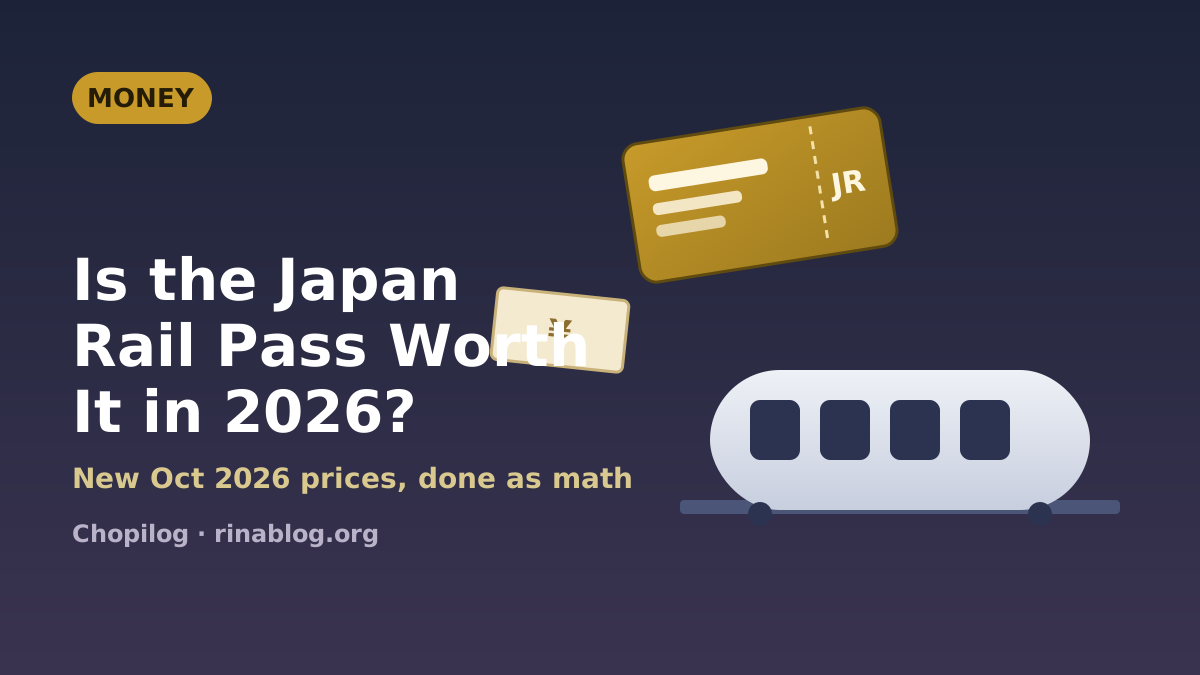
If you've started planning a Japan trip in the last few weeks, you've probably seen the same headline twice: the Japan Rail Pass just went up in price again. We get asked almost every time friends visit whether the pass still makes sense, and the honest answer is "it depends on your route" far more than it used to. Here's the math, done properly, with the October 2026 numbers.
Quick framing: the pass is sold only to short-term foreign visitors on a tourist stamp, not to residents — which includes us, so we've never actually been able to buy one ourselves. What follows is the same spreadsheet we talk friends through before they commit.
What the Japan Rail Pass costs now (October 2026)
JR Group raised prices again on October 1, 2026 — the second big increase since the pass nearly doubled in October 2023. This latest bump is smaller, around 5–6%, but it stacks on top of that 2023 jump, so the pass is a very different deal than it was a few years ago.
| Duration | Ordinary class | Green (first) class |
|---|---|---|
| 7 days | ¥53,000 (~US$345) | ¥74,000 (~US$480) |
| 14 days | ¥84,000 (~US$545) | higher, scaled up |
| 21 days | ¥105,000 (~US$680) | higher, scaled up |
USD figures are rough, at roughly ¥154 to US$1 as of October 2026. For comparison, the 7-day ordinary pass was ¥29,650 before October 2023 and ¥50,000 right after — so today's ¥53,000 is nearly 80% higher than it was three years ago. Children aged 6–11 pay about half the adult rate.
The catch almost nobody mentions: it doesn't cover the fastest trains
This is the part that changes the math the most, and it surprises almost everyone who buys the pass without checking first.
Chopi: Wait, the bullet train pass doesn't work on the fastest bullet train?
Log: Right. Nozomi and Mizuho are off-limits completely — the pass isn't valid even if you pay extra for a seat. You're routed onto Hikari, Sakura, Kodama or Tsubame instead.
On the Tokyo–Osaka corridor, Nozomi is the train that runs most often and that ticket machines suggest by default. Hikari exists on the same line, covered by the pass, and only costs you about 20–25 minutes extra on a Tokyo–Kyoto run. It's a minor inconvenience on that route. If you specifically want a Nozomi or Mizuho seat, you pay a separate supplement — around ¥4,960 one way between Tokyo and Kyoto or Shin-Osaka — on top of a pass you've already paid for, which defeats the point.
Does the math actually work out? A real example
Take the single most common first-timer route: Tokyo to Kyoto and back, nothing else. A reserved-seat Hikari ticket one way is about ¥13,850; round trip, that's roughly ¥27,700. The cheapest 7-day pass now costs ¥53,000. Buying two ordinary tickets saves you nearly ¥25,000, and you haven't even used the pass for anything else.
Now stretch the itinerary. Add a side trip from Kyoto or Osaka to Hiroshima and back — roughly ¥10,000 one way on the Sanyo Shinkansen — and the gap narrows. Add a third or fourth leg (Kanazawa, Nagoya, a loop back through Osaka) within the same 7 days, and a pass bought for long, frequent long-distance hops can pull ahead of buying every ticket separately. Our own site has quoted a one-way Nozomi fare of ¥14,720 for a full run into Tokyo as of September 2026 — stack two or three legs like that inside a week and you can see where the crossover point sits.
The short version: a single out-and-back city pair almost never clears the pass price anymore. A genuine multi-city loop touching three or four distant cities inside 7–21 days still can.
The rule of thumb we actually use with friends: list every one-way long-distance leg of the trip, add up the Hikari/Sakura fares, and compare that single number to the pass price for the matching number of days. If you're only crossing that total once or twice — Tokyo out, Tokyo back — skip the pass. If you're crossing it four, five, six times because you're genuinely circling the country, the pass starts paying for itself. There's no fixed city count that makes it worth it; it's entirely about how many long legs you're stacking into the window you buy.
Cheaper regional passes for shorter trips
If your trip is mostly centred on one region, a nationwide pass is usually the wrong tool. JR sells area-specific passes that are far cheaper and cover exactly the trains you'll actually use.
| Pass | Price (2026) | Good for |
|---|---|---|
| JR Tokyo Wide Pass | ¥16,000 / 3 days | Tokyo, Nikko, Karuizawa, Kawaguchiko day trips |
| Kansai WIDE Area Pass | ¥12,000 / 5 days | Osaka, Kyoto, Kobe, Himeji, Nara, Kinosaki |
| Nationwide Japan Rail Pass | ¥53,000 / 7 days | Long multi-region loops, three-plus distant cities |
Prices and coverage change fairly often, so check the official JR East and JR West pages for your specific dates before you commit to either the regional or the nationwide version.
How to actually buy and use it
You order online and get a QR code by email before you fly. At a JR ticket machine with a passport reader (most major stations have one), you scan the QR code and your passport together, and the machine prints a physical paper pass — it isn't a phone pass and it can't be loaded onto a Suica. That paper goes through the ordinary ticket gates like any other ticket, or you can show it to a staff member at a manned gate. Keep your passport with it; station staff can ask to see both together.
Eligibility matters here: the pass is sold only to people entering Japan as a "Temporary Visitor," the short-term tourist stamp most visitors get on arrival. If you hold a different visa status, including a work or long-term resident visa, you won't be able to buy one even as a foreign national.
FAQ
Can I just pay the Nozomi supplement and still save money?
Sometimes, but do the arithmetic first. The supplement is charged per leg on top of the pass price, so if you're mostly riding Nozomi anyway, you're often better off buying regular Nozomi tickets outright and skipping the pass entirely.
Is there a cheaper pass if I'm only visiting Tokyo or only Kansai?
Yes — the JR Tokyo Wide Pass and Kansai WIDE Area Pass above cost a third to a quarter of the nationwide pass and cover everything most Tokyo-only or Kansai-only itineraries need, including the areas most visitors actually day-trip to.
Does the pass cover the Tokyo subway or our IC card trips around the city?
No. It covers JR trains (plus a few JR-operated bus and ferry routes), not the Tokyo Metro or Toei subway lines, and not city buses outside the JR network. You'll still want a Suica or PASMO loaded for day-to-day city transit — see our Suica vs PASMO vs contactless guide for how that works alongside a rail pass.
Before you book
Map your actual route and add up one-way Hikari/Sakura fares for each leg before you buy anything. If the total beats the pass price, buy individual tickets and save the difference. If you're covering three or more distant cities inside a week, the nationwide pass is still worth pricing against your itinerary. And if a chunk of your trip is one long one-way hop — say Tokyo to Okinawa — check flight prices too; our Tokyo to Miyakojima flights guide shows how that comparison plays out for island routes the rail pass doesn't reach at all. For the cash-and-card side of budgeting the rest of the trip, our Japan travel budget guide covers what else to plan for.