
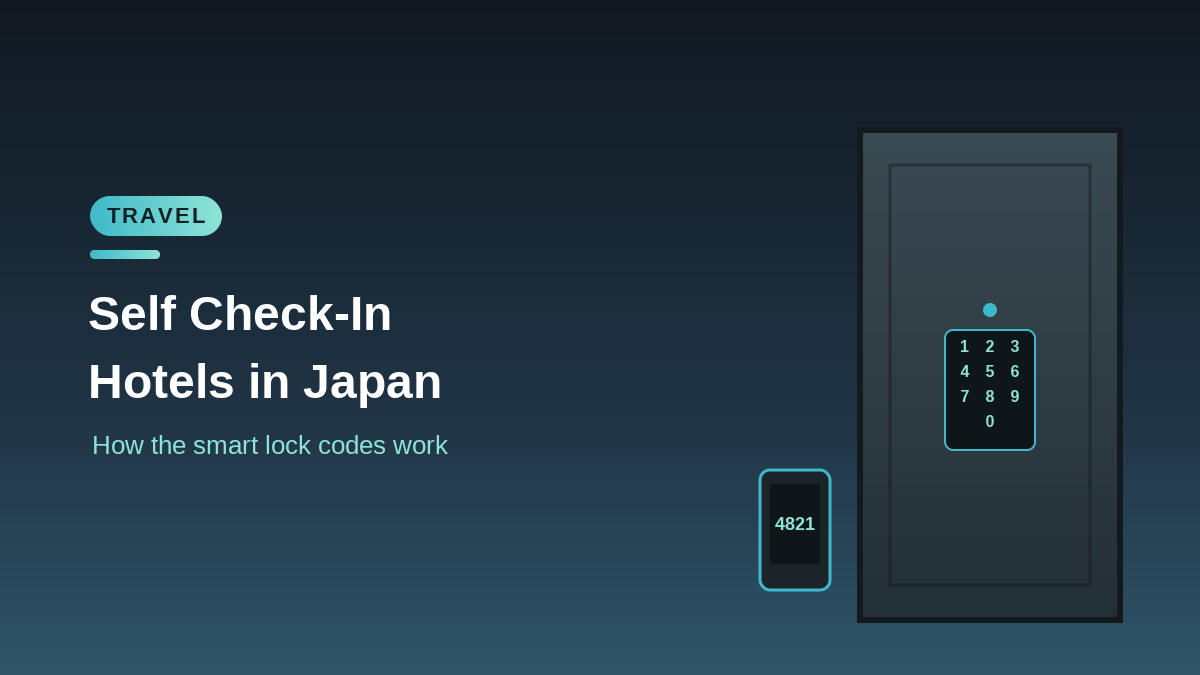
You land in Japan, drag your suitcase to the address on the booking confirmation, and there's no front desk. No lobby. Sometimes no sign at all — just a plain door with a numeric keypad, between a vending machine and someone's actual apartment buzzer. This is a completely normal way to check into a hotel in Japan now, and it trips up a lot of first-time visitors. Here's exactly how the codes work, where they come from, and what to do when one of them doesn't.
Why so many hotels in Japan don't have anyone at the desk
Self check-in isn't a budget gimmick here, it's a response to a real labor shortage in hospitality, and it's spread fast through three kinds of places: licensed minpaku (Japan's regulated short-term rentals, the Airbnb-style apartments and machiya), budget and mid-range city hotels that run on a tablet instead of a person, and a growing number of small independent hotels that simply never built a front desk in the first place. None of this means the place is informal or unregulated — minpaku hosts are still legally required to verify ID and keep records, the checks just move from a person in the lobby to a form you fill out online before you arrive.
How the codes actually get to you
The timeline is almost always the same, give or take a day:
- 1–2 days before arrival: an email or SMS with a PIN code, a link, or both. Save it — don't rely on having signal the moment you need it.
- On arrival: you may need a separate code just to get into the building itself (an intercom panel or keypad by the street-level door), and then a second, different code for the smart lock on your actual room or unit.
- At some properties: a tablet in a small unstaffed lobby handles the actual check-in step — you confirm your name and booking, and it prints or displays the room number and a fresh code for that specific door.
The part that catches people out is that these are frequently two different codes, not one. Treating the building entry code and the room code as the same thing is the single most common reason people think they're "locked out" when they're really just standing at the wrong door.

Isn't it weird walking into a hotel with nobody there to greet you?

We stayed at a smart-lock place in Miyakojima once — the door just took a PIN code, or you could unlock it remotely from a link the hotel emailed us. チェックインの説明がない。そのまま部屋に入ってすぐくつろげる ("no check-in explanation — you just walk straight in and relax") was literally the plus point in our notes. It was genuinely easy. The only part that gave us pause was realizing an older relative would probably have found the keypad fiddly on a first try.
If your code doesn't work
Before assuming anything is broken, work through this in order:
- Check the time. Codes are often programmed to activate only from the official check-in hour (commonly 15:00 or 16:00), not the moment you receive the email. Arriving early and getting a dead keypad is normal, not a fault.
- Check you're reading the right code for the right door. Re-open the booking email and separate "building" from "room" if both exist.
- Check the date. Some systems only issue or activate the code on the day of arrival itself, not the day before.
- Call the number on your booking confirmation — not a general hotel-chain hotline, the specific line for that property or listing. Have your reservation name, booking number, and arrival time ready. Many operators can unlock the door remotely from their end if the lock is still connected, or talk you through a backup key box.
- If nobody answers, move to somewhere lit and public — a convenience store or station nearby — rather than standing alone at an unlit entrance repeatedly trying codes, and contact the booking platform (Booking.com, Agoda, Airbnb) as a second channel while you keep trying the property directly.
Screenshotting the exact error (a red light, a "code not recognized" message) before you try again a few times gives whoever you call something concrete to work with, instead of just "it's not opening."
Don't assume you can drop bags off early
At a staffed hotel, leaving your suitcase at the desk before check-in is routine. At a self-check-in place, there's often no one to hand it to and nowhere designated to put it — the door simply won't open until your window starts. If you're arriving hours before check-in, plan around a coin locker or a short-term luggage service instead of assuming the property will sort it out on arrival; see our guide to luggage storage and forwarding in Japan for where those are.
What kind of place are you actually booking?
| Type | Who checks your ID | When you get your code | If something goes wrong |
|---|---|---|---|
| Standard business hotel | Front desk staff, in person | No code — key or card handed over at check-in | Ask the person in front of you |
| Capsule hotel | Usually staffed, sometimes a kiosk | Locker code or key fob at check-in | Staff on site; see our capsule hotel guide |
| Self-check-in budget/city hotel | Online form in advance, tablet kiosk on arrival | PIN by email/SMS 1–2 days before, activated at check-in time | Property's own phone line, usually posted at the entrance too |
| Licensed minpaku / Airbnb | Online, before arrival (passport photo for some) | Separate building and room/key-box codes, by email | Host's phone/app; booking platform as backup |
A few things worth doing before you leave for the airport
- Screenshot or download the check-in instructions and both codes — don't count on finding signal exactly when you need it. If you're relying on an eSIM for the call or the map, see our eSIM troubleshooting guide.
- Label which code opens what if a host sends more than one — "building" vs "room" written down saves you fumbling at the door.
- Note the property's actual phone number somewhere that doesn't depend on opening the booking app (a photo of the confirmation page works).
FAQ
Is a self check-in hotel in Japan less safe than a staffed one?
No — licensed minpaku and self-check-in hotels still have to verify guest identity and keep records, it just happens online before you arrive instead of at a desk. The thing to watch for isn't the keyless lock itself, it's a listing that skips ID verification altogether, which is a red flag regardless of how check-in works.
What if I don't have a working phone when I arrive?
This is the real risk with self check-in, not the lock mechanism. Confirm before you travel that your phone will have a working data or voice connection at arrival — borrowed airport wifi isn't reliable enough to troubleshoot a dead keypad at 11pm.
Do I still need to show my passport?
Usually yes, just not necessarily to a person. Many self-check-in properties collect a passport photo through the booking form instead of at a desk; see our full guide to passport checks at Japanese hotels for how that works.
Self check-in in Japan is routine, not a downgrade — but it only works smoothly if you treat the codes as something to prepare, not something to wing. Save the instructions before you leave the airport, and you'll be inside faster than you would have been waiting at a front desk.