
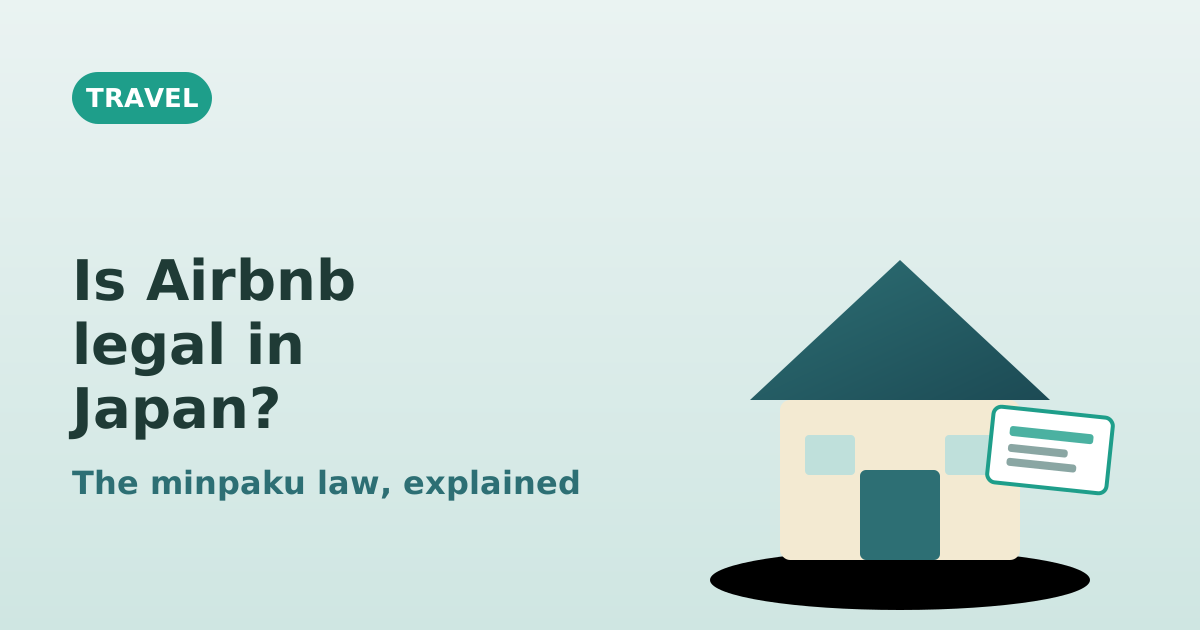
Short-term rentals in Japan are not a gray area the way they are in some cities — they run on an actual law, with a name, a cap on nights, and a number every legal listing has to show. The confusing part for visitors is that there are three different licenses a host can be operating under, and only one of them caps the year at 180 nights. Here's what each one means for the dates you're trying to book, and how to tell a legitimate listing from one that's quietly operating outside the rules.
Yes, it's legal — under one of three licenses
Japan's 2018 Private Lodging Business Act (Jutaku Shukuhaku Jigyō Hō, often shortened to "minpaku law") was written specifically to bring Airbnb-style rentals into the open after years of hosts operating without any license at all. A host renting out a home short-term in Japan today is doing it under one of three routes:
- Standard minpaku (住宅宿泊事業) — a notification filed with the local government, capped at 180 nights a year.
- Hotel Business Act license (旅館業法) — the same license a small inn or ryokan uses, with no annual night limit, but it requires health-department approval and meeting building and fire-safety standards.
- Special zone minpaku (特区民泊) — only available in a short list of designated National Strategic Special Zones (parts of Tokyo's Ota ward, Osaka, and a few other cities), usually with a minimum stay of two or three nights.
All three are legal. What's illegal is a fourth category: a listing with none of the above, usually an apartment someone is renting out on the side without telling anyone. Those still turn up on booking sites occasionally, which is why the number matters more than the platform.
The 180-night cap, and why it matters for your dates
For a standard minpaku listing, Japan's Ministry of Land, Infrastructure, Transport and Tourism (MLIT) sets the limit at a maximum of 180 operating nights per year, counted from April 1 to the following April 1 — not the calendar year. Hosts running close to popular periods (cherry blossom, Golden Week, autumn leaves) tend to use up their nights faster, which means a listing that was wide open when you first searched can simply vanish from the calendar a few months later, with no explanation and nothing wrong with the booking itself.
Chopi: Wait, so the room isn't gone because someone else booked it? Log: Sometimes, sure — but sometimes the host just hit their yearly limit and the calendar locks up until April.
A friend who stayed at a minpaku-licensed room in Kyoto last year watched exactly that happen mid-search: the same listing that was available for their first week quietly closed its calendar for the following two weeks in the middle of autumn, the host's busiest stretch. Nothing was wrong with it — it had simply run out of nights for that cycle.
The other two routes don't have that problem
A property operating under a full Hotel Business Act license isn't capped at 180 nights, because it's legally the same category as a small inn — it just needs health-department sign-off and to meet the same building and fire-safety standards. These tend to be whole small guesthouses or buildings rather than someone's spare room, and you'll usually see "simple lodging" (簡易宿所) in the fine print rather than "minpaku."
Special zone minpaku sits in between: no annual cap, but it only exists in a handful of designated zones, and almost always requires a minimum stay of two or three nights rather than a single night. It was built for exactly this market — short visits, not long-term housing — so a one-night booking usually isn't an option under this license even when the listing itself has no yearly limit. Some cities have also been tightening this route rather than expanding it; Osaka, for instance, paused new special-zone applications in 2026, so the supply of these listings isn't guaranteed to grow.
How to check a listing is legal before you book
The one piece of information every legal listing has to carry is a notification or license number — the host is legally required to display it, and on Airbnb it's supposed to appear in the listing details (look under "Read more about the space"). The exact format isn't identical nationwide since each prefecture or city issues its own, but you're looking for something that reads like an official reference number, not a marketing phrase. No number anywhere on a whole-home listing is the clearest red flag.
Beyond that, there isn't one simple national website where you type in an address and get a yes/no — some municipalities publish their registered properties as PDF lists, and a growing number have stopped publishing numbers at all for privacy reasons, so an absent list doesn't automatically mean a property is unlicensed. In practice: check for a number in the listing, and when you arrive, check for a small physical placard near the entrance with a notification number printed on it — hosts under all three licenses are required to post one.
What this means at check-in
Whichever of the three licenses a host is operating under, they're required to keep the same lodger register that hotels and ryokan keep, and for guests without a Japanese address — which covers almost every foreign tourist — that means showing your passport so the host can record your name, nationality, and passport number. It isn't a minpaku-specific hassle; it's the identical rule that applies at a licensed hotel, which we cover in more detail in our guide to passport checks at Japanese hotel check-in.
Minpaku vs. the licensed alternatives
| Standard minpaku | Hotel Business Act (simple lodging) | Special zone minpaku | |
|---|---|---|---|
| Annual night limit | 180 nights (Apr–Apr) | None | None |
| Typical property | A room or whole home in someone's residence | A small dedicated guesthouse or building | An apartment in a designated zone |
| Minimum stay | Usually none | Usually none | Typically 2–3 nights |
| Where available | Nationwide, subject to local rules | Nationwide | Only designated special zones |
If a long, flexible stay in one city matters more to you than finding the cheapest room, the Hotel Business Act listings are the steadiest option precisely because they don't have a nights cap. If you just want a normal budget base in Tokyo for a few nights, it's often simpler to skip the legality question entirely and book a regular budget hotel — our guide covers which areas are worth it.
What changed in 2026
Japan's tourism authorities have been moving toward giving local governments more power to restrict minpaku in residential neighborhoods, including letting some municipalities set the operating limit as low as zero nights in designated residential zones — a response to noise and neighbor complaints that predate the law itself. The practical effect for travelers is the same either way: a listing that looked available last month can disappear from a neighborhood entirely, not just run out of nights for the season. If a specific area matters to your trip (close to a particular station, a specific neighborhood), book earlier rather than assuming the same inventory will still be there closer to your dates.
FAQ
Is Airbnb itself illegal in Japan?
No — the platform is legal and widely used. What the law regulates is the individual listing, not the platform. A listing can be fully legal or completely unlicensed on the exact same app, which is why checking for a notification number matters more than which site you booked through.
What happens if I accidentally book an unlicensed listing?
You're not the one breaking the law — the operator is — but an unlicensed stay has no safety or hygiene inspection behind it, and if the authorities do shut it down, you could be left finding a new place to stay with no notice. It's worth the thirty seconds it takes to check for a number before you pay.
Can a confirmed minpaku booking still get canceled on me?
It's uncommon once a booking is confirmed, but it can happen if a host miscounted their remaining nights for the year or a local rule changes. If you're booking a standard minpaku listing for dates months out, it's worth a quick message to the host confirming the stay is within their year's allowance, especially during the busiest travel seasons.
None of this is a reason to avoid minpaku — most listings on major platforms are licensed, and a short-term rental is often the only way to get a kitchen and a living room in cities where that's rare at hotel prices. It just helps to know what the number on the listing is actually telling you, and why a perfectly good room sometimes blinks off the calendar for reasons that have nothing to do with you.