We lived on Miyakojima for a while, close enough to the reef that we could smell the tide from the kitchen window. One thing you notice living next to that water, instead of just visiting it: how often the warning signs are about currents, not sharks. Rip currents past the marked swim areas, a gust that turns a flat morning into a cancelled afternoon dive. Nothing dramatic ever happened to us. But it's exactly why, before every dive trip since, we've actually read the fine print on what our insurance covers — not assumed it, read it. Most visiting divers never get around to that part.
This isn't a scare piece. It's the practical version: how often things actually go wrong in Japan, what a dive shop's own insurance does and doesn't pay for, whether the DAN membership or travel policy you already have at home is worth anything here, and the two numbers worth saving in your phone before you get in the water.
Isn't this the kind of thing you just hope you never need?
Sure — but the people who end up stuck are the ones who hoped instead of checked. Takes five minutes to check.
How common are diving accidents in Japan, really?
The Japan Coast Guard publishes annual numbers for marine leisure accidents, and the most recent report (released January 2026, covering 2025) counted 702 people involved in marine-leisure accidents nationwide, 206 of whom died or went missing, and 50 of whom were foreign nationals — down from 60 the year before, but up from 34 two years earlier (Japan Coast Guard, confirmed October 2026). Important caveat: that figure covers all marine leisure activities — swimming, fishing, SUP, snorkelling, and diving together. The Coast Guard's public report doesn't break scuba diving out as its own line, so there's no clean "diving accidents per year" number to quote, and we're not going to invent one. What the number does tell you is that water leisure in Japan carries a real, non-zero risk, and that a meaningful share of the people affected each year are visitors rather than residents.
What actually tends to go wrong
Three things show up again and again in dive-safety guidance here, and none of them are exotic. Being in worse shape than you realised — short sleep, a hangover, a cold — which slows reactions and judgement underwater. Diving conditions that outrun your experience: a stronger current or ちょぴer surface than you're used to, pushed through anyway because the trip is booked and the weather window is short. And separating from your buddy or guide, which turns a small problem into a slow-help one. Each of those is something you, not the shop, control on the day — cancel if you're unwell, say so if the conditions feel like more than you bargained for, and stay close to your guide. If you're working toward certification, the health-declaration form you fill out before the course exists for exactly this reason; our guide to getting a diving licence in Japan covers what's actually on it.
Shop insurance, your own insurance — they're not the same thing
Every legitimate dive shop in Japan carries liability insurance. It's easy to hear "the shop is insured" and assume you're covered. You're not, not directly — liability insurance protects the shop if it's found negligent; it isn't the same as a policy that pays your hospital bill. There are three layers worth knowing apart:
| Type | Who it actually protects | What to check |
|---|---|---|
| Shop's liability insurance | The shop, if it's sued | Doesn't automatically pay for your treatment |
| Dive-accident insurance (DAN or similar) | You | Decompression sickness treatment, chamber costs, medical evacuation |
| General travel insurance | You | Scuba is a common exclusion — check the policy wording, not just the brochure |
That middle row is the one most visiting divers skip, and it's the one that actually matters if something goes wrong underwater specifically.
Does the dive insurance you already have at home follow you here?
If you're coming from the US, UK, Australia, or Singapore, there's a decent chance you already have some kind of DAN membership from your own certification course. The organisation is regional — DAN America, DAN Europe, DAN Asia-Pacific — but all of them sell worldwide coverage tiers, and Japan isn't excluded from any of them. DAN Asia-Pacific's current plans run from about ¥13,400 (around US$85) for a domestic-only tier up to about ¥23,700 (around US$150) for the broadest worldwide plan, covering emergency medical transport from US$10,000 up to US$150,000 and dive-accident medical expenses from US$50,000 up to US$250,000 per occurrence, depending on the tier (DAN World, confirmed October 2026; JPY figures approximate at ¥158/US$1, October 2026). Rates and limits change, so check the current numbers before you rely on them.
If you've never joined DAN and don't want an annual membership for one trip, there's a short-term option: DAN World's short-term dive accident coverage, sold through participating dive shops rather than directly to divers, covering emergency evacuation up to US$150,000 and dive-accident medical care up to a US$125,000 lifetime maximum (DAN World, confirmed October 2026). Not every Japanese shop sells it, so ask when you book rather than assuming — it's a fast question to ask alongside the ones in our Okinawa diving guide about choosing a shop.
One thing worth separating out: DAN Japan, the domestic organisation, runs its own leisure-diving insurance for members based in Japan, and its published terms assume the policyholder lives here — coverage doesn't apply if you join while already travelling abroad. It's not built for a short visit, so don't treat it as your option; your own country's DAN org or a travel policy that explicitly includes scuba is the one that's actually built for a trip like this.
If something does go wrong: the numbers worth saving before you get in the water
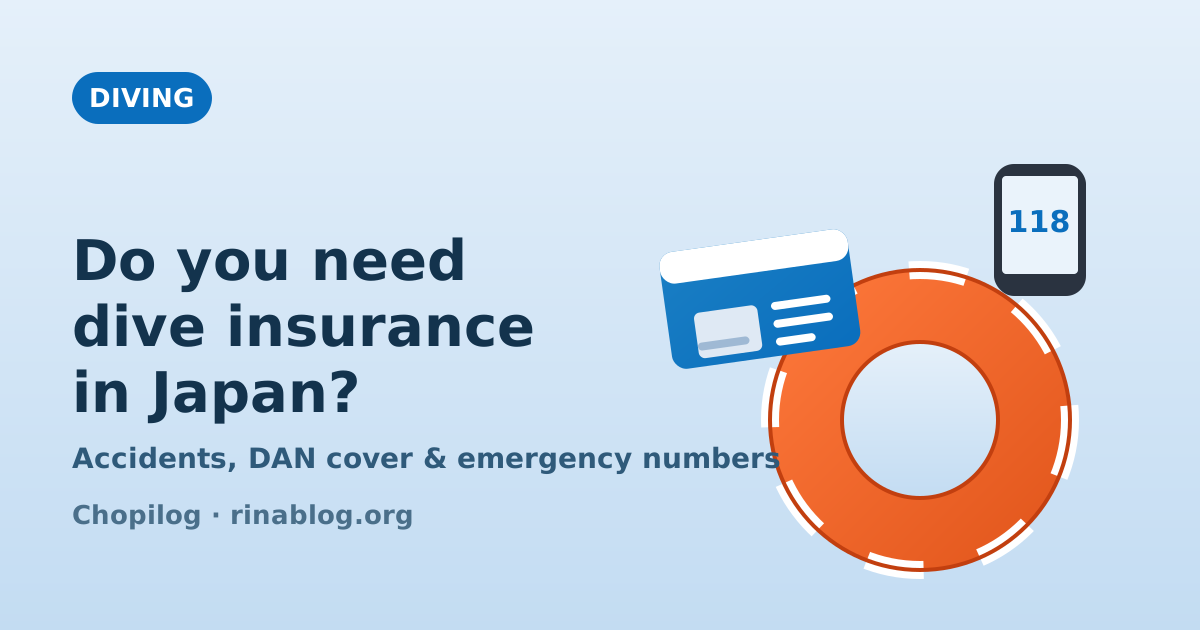
For an accident at sea, the number is 118 — the Japan Coast Guard's dedicated maritime emergency line, reachable from any mobile or landline in Japan, with English-speaking operators available (Japan Coast Guard, confirmed October 2026). For an ambulance or fire emergency on land, including right after you're back on the boat, it's 119, same as anywhere else in Japan. Neither replaces calling your dive shop first if you're still on a trip they're running — the instructor on site can usually move faster than a number you dial yourself.
Decompression sickness is the specific risk that makes diving different from other water sports, and it doesn't always show up immediately — symptoms like joint pain, tingling, or unusual fatigue can appear hours later, sometimes after you've already left the dive site. Okinawa's main island has a hospital with a hyperbaric oxygen chamber for exactly this: Nanbu Tokushukai Hospital in Yaese, in the south of the main island, which lists a hyperbaric oxygen therapy room among its facilities (Nanbu Tokushukai Hospital, confirmed October 2026). If you're diving from one of the outer islands — Miyakojima, Ishigaki — ask your shop in advance which chamber they'd send you to; distance matters with decompression sickness, and it's a better question to ask on dry land than to work out mid-emergency. Don't talk yourself out of symptoms because they're mild or you're not sure. "Probably fine" isn't a diagnosis.
FAQ
Does my regular travel insurance cover scuba diving in Japan?
Sometimes, but scuba is a common exclusion on standard travel policies, or it's covered only up to a shallow depth, or only for a "try-dive" and not a certified dive. Check the actual policy wording for the word "diving" or "scuba" before you fly — don't assume general medical cover extends to it.
Do I need DAN membership specifically, or is any dive-accident policy fine?
DAN is simply the best-known name; other dive-accident insurers exist and some travel insurers now offer a scuba add-on. What matters is that the policy explicitly covers decompression sickness treatment and chamber costs, not the brand on the card.
What's the fastest way to get help if something goes wrong on a dive in Japan?
Tell your instructor or dive guide first — they're trained for this and already know the nearest facility. If you need to call yourself, 118 is the Japan Coast Guard's maritime emergency line (English-speaking operators available) and 119 covers ambulance and fire on land.
None of this is meant to make diving in Japan sound riskier than it is — most trips end with sunburn and good photos, not a phone call to anyone. It's just worth five minutes before you go: know what your shop's insurance doesn't cover, confirm what yours actually does, and save 118 in your phone next to the dive shop's number. If you haven't settled on where to dive yet, our guide to diving in Okinawa compares the main spots, and if you're getting certified on the trip, getting a diving licence in Japan covers the medical form and the course itself.