
The night before our first trial dive in Miyakojima, we sat on the floor of our apartment with every drawer open, trying to guess what we actually needed to bring. It turns out the answer is: less than you think. The dive shop supplies the heavy, expensive gear. What you pack yourself is a short, specific list — and getting it right means you're not standing on the beach in the wrong shoes, sunburned, or digging through a soaked tote bag on the drive back.
Chopi: So what do we actually have to buy?
Log: Almost nothing. A swimsuit and some reef-safe sunscreen, basically. Everything heavy gets rented.
What the shop already has waiting for you
For a trial dive (no license required) in Okinawa, Miyakojima, or Ishigaki, the shop provides the wetsuit, mask, fins, tank, BCD (the inflatable vest that holds the tank), and regulator. These are the items that are expensive to buy, awkward to pack, and need fitting anyway, so almost every shop includes them in the trial-dive price. Some shops will also lend a rash guard or marine shoes if you ask — it's worth a quick email or phone call before you go, both to confirm what's included and to check your size is in stock. If you're also deciding whether to go for a certified license on the same trip, our guide to getting a diving license in Japan covers what the course itself requires.
The actual packing list
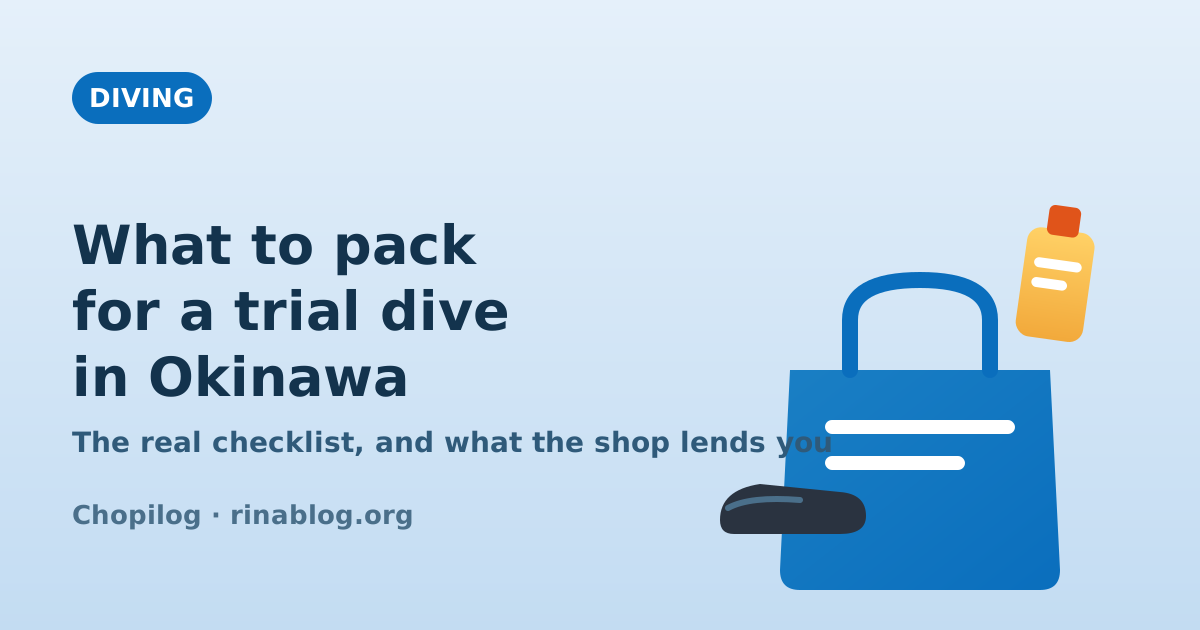
Here's the full list, sorted by how much it matters. The reasoning for each is below.
| Item | How essential | Why |
|---|---|---|
| Swimsuit (worn under your clothes) | Must-have | Cuts down on changing-room time once you arrive |
| Two towels (one large, one small) | Must-have | Large for your body, small one for hair |
| A full change of clothes, down to underwear | Must-have | You will be wet and salty afterward |
| Reef-safe sunscreen | Recommended | Mineral formulas are gentler on coral (details below) |
| Sandals or marine shoes | Recommended | Protects feet from sand, rock and coral fragments on beach entries |
| Water bottle | Recommended | Diving is more dehydrating than it feels |
| Motion sickness tablets | Situational | Boat dives only — ask a pharmacist or doctor before using any |
| Spare contact lenses, case, rewetting drops | Situational | Only if you wear contacts — details below |
| A waterproof or zip-top bag | Nice to have | For your phone, wallet, and the wet swimsuit on the way home |
The swimsuit, and what goes over it
Wear your swimsuit under your regular clothes when you leave your hotel — it saves you from queueing for a changing room once you're there. Over it, a rash guard (long-sleeved if you burn easily) protects against sun, jellyfish stings, and the friction of a wetsuit rubbing against bare skin. You'll be given a wetsuit to go over this, so the rash guard just needs to be something thin you're comfortable wearing underneath, not a wetsuit replacement.
Footwear matters more than people expect. Beach-entry trial dives often mean walking over sand that turns to broken coral and rock near the water's edge, and flip-flops come off easily at exactly the wrong moment. Shoes that cover the heel are the safer bet.
Getting home without a soaked bag
Pack something easy to peel on and off for the ride back — your hair and skin will still be damp, and air conditioning in a car or bus can leave you cold fast, so a light layer to throw on helps. The one thing people forget every single time is a dedicated bag for the wet swimsuit and towels. Without one, everything else in your bag gets damp too. A simple zip-top bag or a dry bag solves it, and the same bag doubles as protection for your phone and wallet if you're leaving them on the beach rather than locked in a car.
Reef-safe sunscreen: what it means and where it's required
Two common sunscreen ingredients, oxybenzone and octinoxate, have been shown to harm coral at a cellular level, and NOAA points to mineral sunscreens as the better option because they affect aquatic life less than chemical UV filters. This isn't just guidance: Hawaii banned the sale of sunscreens containing oxybenzone and octinoxate (the law was signed in 2018 and took effect January 1, 2021), and Palau went further, banning ten reef-harmful ingredients outright from January 1, 2020, with fines for shops that sell them and confiscation at the point of entry for travelers carrying them.
Japan hasn't passed a law like either of those, so you won't be stopped at customs over it. But look for "reef safe" or "reef friendly" labeling, and check the ingredient list for zinc oxide or titanium dioxide (mineral/physical blockers) rather than oxybenzone or octinoxate. A long-sleeved rash guard also means you need less sunscreen in the first place, which is the simplest fix of all.
Diving with contact lenses or glasses
If you wear glasses, you dive without them and rely on the shop's instructor cues and your own sense of direction — or you can look into a prescription dive mask in advance, though these cost more and need to be ordered ahead of a trip. If you wear contacts, soft disposable lenses are generally fine to dive in. According to guidance summarized by PADI, citing Divers Alert Network research, hard or rigid gas-permeable lenses are the ones to avoid: they don't let gas pass through, so tiny bubbles can form between the lens and your eye, leading to blurry vision or discomfort during and after the dive. Soft lenses are larger, more likely to stay put if your mask floods, and rarely cause problems — though the pressure of a dive can occasionally make a soft lens feel stuck, which is what rewetting drops are for. If diving with contacts worries you at all, it's worth asking the shop directly when you book; most have had the question many times before.
What to leave at home
A big bag is just something to babysit on the beach. Leave expensive jewelry and watches behind — they're easy to lose in the water and nobody is diving down to look for your ring. Carry only the cash you'll actually spend that day. If you're nervous about your phone and wallet, that's exactly what the waterproof bag from the list above is for; it's a much better solution than trying to leave valuables unattended in a locker-free beach setup.
Packing a little differently by season
In summer, lean harder into sun protection: a hat, sunglasses for the boat ride, and a travel-size sunscreen for reapplying after you towel off. In cooler months — spring, autumn, or winter — the shock isn't the water itself (the wetsuit handles that) but the minutes right after you climb out, when wind on wet skin gets cold fast. Bring a warm layer to put on immediately and dry clothes you can change into quickly. An extra small towel for your hair is worth packing in winter too, since not every shop has a hairdryer. Either way, pack more water than you think you need: breathing compressed air and spending an hour in the sun is more dehydrating than a normal beach day.
FAQ
Do I need to buy or rent my own mask and fins?
No. For a trial dive, the shop provides the wetsuit, mask, fins, tank, BCD, and regulator as part of the price. Call ahead if you want to confirm a rash guard or marine shoes are also available to rent.
Can I dive with contact lenses?
Soft disposable lenses are usually fine, with a spare pair, a case, and rewetting drops as backup. Rigid gas-permeable (hard) lenses are the type to avoid, since they can trap gas bubbles against the eye and cause blurry vision.
What sunscreen should I bring?
Look for a mineral sunscreen with zinc oxide or titanium dioxide rather than oxybenzone or octinoxate. It's not legally required in Japan the way it is in Hawaii or Palau, but it's gentler on the coral you're there to see.
Once your bag is packed, the two things worth checking next are how your ears will handle the pressure change (our guide to equalizing your ears while diving covers the technique) and, if this is the last stop on your trip, how long to wait before flying after a dive. Pack light, rent the heavy stuff, and the only thing you'll actually be carrying home is sand in your shoes.