
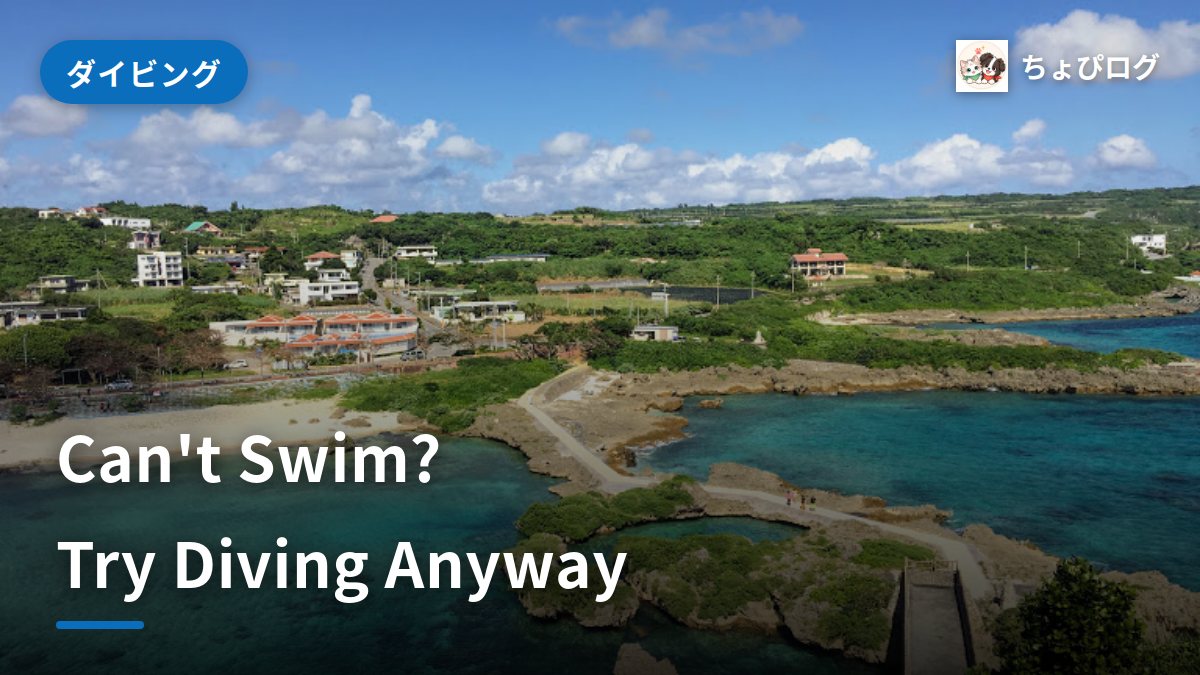
Chopi can't swim 25 metres without stopping. For a long time that felt like a hard no on ever trying scuba diving in Okinawa — until we actually asked a dive shop and found out we had the wrong picture entirely. A trial dive (sometimes called a "discover scuba" or, in Japanese, a taiken dive) is built around floating and breathing, not swimming laps. Here's what shops actually require, what you should tell them before you book, how that's different from the full certification course, and what to do beforehand if the idea still makes you nervous.
A trial dive is about floating, not swimming
The biggest misconception is that scuba diving works like a swimming pool class — kick hard, pull with your arms, keep your head above water. It doesn't. Once you're geared up, a buoyancy control device (BCD) and a wetsuit hold you at the surface without any effort on your part, the same way a life jacket would. Underwater, you move slowly with fins instead of swimming freestyle, and an instructor is right next to you the entire time. Whether you swam 25 metres in a school test or never finished a lap in your life has very little to do with whether you can do this.
Why non-swimmers can still do a trial dive
There are three specific reasons this works, and they stack on top of each other:
| Reason | What it means |
|---|---|
| The gear keeps you afloat | The BCD and wetsuit provide buoyancy on their own — you don't sink the moment you stop kicking |
| An instructor stays with you | For a trial dive, PADI requires an instructor (or, for a pool-only session, a divemaster) by your side from start to finish — often holding your hand or arm |
| You start shallow | Trial dives begin in a pool or in calm, shallow water with good visibility, and you get used to breathing through the regulator before going any deeper |
PADI's own guidance for Discover Scuba Diving (checked October 2026) puts it plainly: you don't need advanced swimming skills, just enough comfort in water to "maintain yourself at the surface." There's no lap to complete and no stopwatch. Breathing underwater through a regulator — in and out, same as normal — is a different skill from swimming, and it's the one the whole experience is actually testing.

I genuinely can't swim 25 metres without stopping. Is it rude to even sign up for a trial dive?

Not at all — shops plan for it. The only rude move is not telling them. Say it when you book, and they'll already know how to pace your day.
What to tell the shop before you book
Being honest about two or three things up front changes how a shop prepares for you — it doesn't get you turned away.
- That you can't swim, or swim weakly. Say it when you reserve, not when you're standing on the boat. A shop that knows in advance can put you with the right instructor and plan a shallower first few minutes.
- If putting your face in water genuinely scares you. This is different from not swimming well, and it matters more. A fear of water that you push through anyway is how a dive turns into a panic. Say it plainly, and ask whether you can start with just breathing through the regulator at the surface before your face goes under.
- Medical conditions, medication, or pregnancy. PADI's intake process includes a medical questionnaire, and depending on your answers you may need a doctor's note confirming you're fit to dive. Don't self-diagnose as "probably fine" — let the form and a doctor make that call.
- How you feel on the day. A cold, a rough night's sleep, or a hangover are all reasons a shop may ask you to reschedule. That's a normal, sensible outcome, not a failure.
Thinking about getting certified later? The bar moves
A trial dive and the full Open Water certification course are not the same requirement, and it's worth knowing the difference before you decide which one to book. A trial dive has no formal swim test. The certification course does:
| Trial dive (Discover Scuba) | Open Water certification course | |
|---|---|---|
| Swim test | None — just "comfortable in water" | 200 m with no gear, or 300 m with mask, fins and snorkel — no time limit, any stroke |
| Float / tread | Not required separately | 10 minutes, any method (floating on your back counts) |
| Length | A few hours, one day | 2–3 days |
| Depth you're cleared for after | None — it's a one-off experience, not a qualification | Up to 18 m, with a buddy |
If a 200–300 metre swim sounds impossible right now, that's genuinely fine — it doesn't rule out a trial dive today, and plenty of people who couldn't manage that swim on day one work up to it later with practice. We cover the certification course, its real cost, and what the course days look like in our guide to getting a diving licence in Japan.
Three things that make the day easier, no training required
You don't need to practise anything athletic beforehand. What actually helps is smaller than that:
- Get used to the sensation at home first. In the bath or shower, put your face in the water and breathe out through your mouth. That's most of what the regulator feels like — it removes the surprise.
- Decide in advance that stopping is allowed. Agree on a hand signal with your instructor for "I want to stop," and give yourself permission to use it. Knowing there's an exit is what keeps most people calm enough not to need it.
- Sleep well, skip the alcohol the night before. Dive shops ask this for a reason — being tired or dehydrated makes the whole experience harder than it needs to be, and it has nothing to do with swimming ability.
If the water itself still feels like too much: snorkelling first
If the honest answer is that water makes you anxious rather than just being an unpracticed swimmer, there's no reason to force a trial dive before you're ready. Snorkelling with a life jacket, floating face-down at the surface in shallow water, is a lower-pressure way to get comfortable with a mask and breathing through your mouth, and you can move to a trial dive once that feels easy. Our guide to Okinawa's best beaches covers calm, shallow spots good for exactly this.
FAQ
Do you need to know how to swim for a trial dive in Okinawa?
No formal swim test is required. PADI's standard is that you feel comfortable in water and can maintain yourself at the surface — the BCD and wetsuit do the floating, and an instructor is with you throughout. Tell the shop when you book if your swimming is weak or non-existent.
What if I'm scared of putting my face in the water?
That's a different issue from swimming ability, and it's worth saying out loud when you reserve. Ask whether you can ease in — breathing through the regulator at the surface first, face in the water only once that feels normal. If the fear is strong, consider snorkelling in shallow water first instead of pushing through on a trial dive.
Is the swim test different if I want to get certified instead of doing a one-off trial dive?
Yes. A trial dive has no swim test. The Open Water certification course does: a 200 m swim with no gear, or 300 m with mask, fins and snorkel, plus a 10-minute float or tread — no time limit and any stroke or method is accepted.
Not being able to swim well is a reason to say so when you book, not a reason to rule out the water entirely. Tell the shop the truth, start shallow, and decide for yourself whether certification is a later step or not a step you need at all. Our Okinawa diving overview is the place to start picking a spot and a shop.