
On our first try-dive in Okinawa, the thing nobody warned us about wasn't the fish or the current — it was how fast a dull ache can build up in your ears if nobody tells you to equalize before it starts. It's the same pressure you feel landing on a plane, except water is roughly 800 times denser than air, so the squeeze shows up much sooner and much harder. Here's how ear equalization actually works, the techniques instructors teach on a trial dive, what to do when it won't clear, and when the right call is simply to stop.
Why diving makes your ears hurt
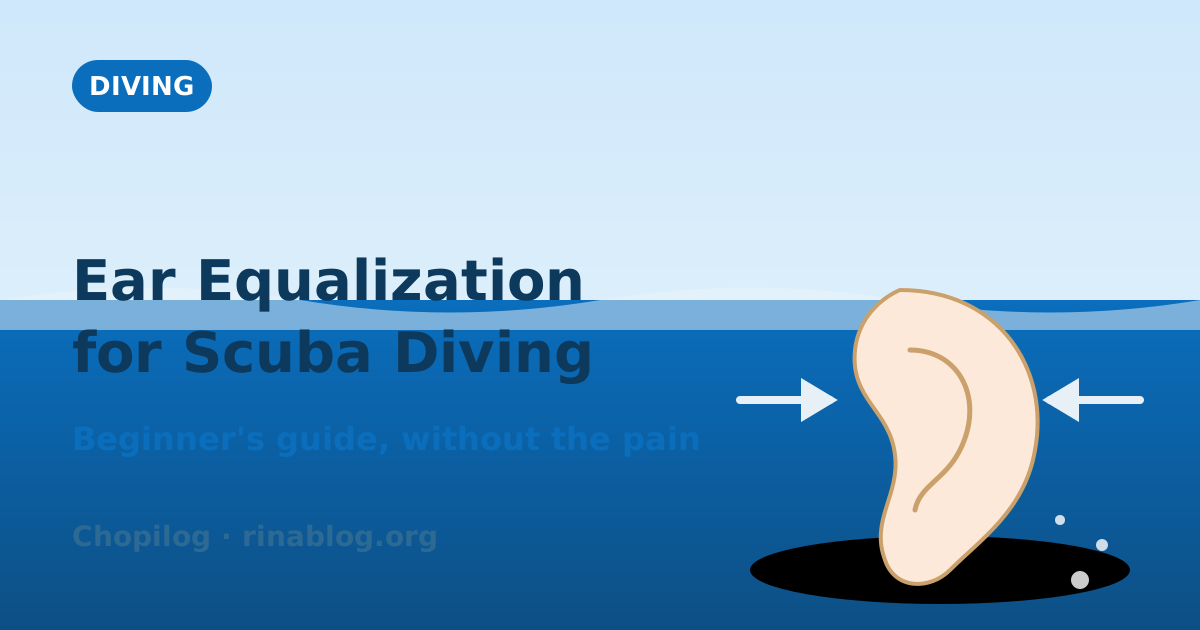
As you descend, water pressure rises quickly and pushes in on your eardrum from the outside. Your middle ear, on the inside, stays at the pressure it was at the surface — so a gap opens up between the two sides, and that gap is what you feel as pain. Equalizing means sending air up the Eustachian tube, from the back of your nose to the middle ear, to close that gap. According to DAN World (Divers Alert Network, checked November 2026), the eardrum can start leaking fluid or bleeding at a pressure difference of around 5 psi, and will usually rupture past 10 psi if nothing is done — which in practical terms is only a few metres of water. That's why the advice is never "push through it."
The techniques instructors actually teach
You won't need to memorize any of this before you go — an instructor talks you through it in the water. But knowing the names in advance makes the briefing click faster:
| Technique | How to do it |
|---|---|
| Valsalva maneuver | Pinch your nostrils shut (or press them against your mask skirt), close your mouth, and blow gently through your nose — this is the one almost every instructor teaches first |
| Toynbee maneuver | Pinch your nostrils shut and swallow |
| Yawn / jaw-wiggle | Move your jaw forward or side to side as if yawning, without pinching your nose at all |
PADI's own guidance (checked November 2026) frames the Valsalva maneuver as the default starting point, with Toynbee and jaw movements as backups if it doesn't work for you. The common thread across all of them: gentle pressure, not force. Blowing hard enough to clear your sinuses on land is already too hard for your ears underwater.

Equalizing is just the thing I already hate on every flight, isn't it? That awful ear-popping feeling?

Same mechanism, just a lot stronger. On a plane the cabin pressure changes slowly over several minutes. Underwater it changes with every metre you drop, so you have to do it on purpose and keep doing it, not wait for your ears to pop on their own.
Equalize early, equalize often
Timing matters more than technique. DAN World's guidance is to gently equalize every few feet for roughly the first 10 to 15 feet (about 3–4.5 metres) of descent, since that shallow range is where the pressure change is relative to depth is greatest. In practice that means: equalize once at the surface before you even duck your head under, then again every metre or so on the way down — before you feel any pressure, not after. This is also why a trial dive always starts in shallow water. It's not just to build confidence; it's giving your ears the easiest part of the pressure curve first, with an instructor right there to notice if you're struggling.
If it won't clear, don't push through the pain
This is the part worth saying plainly: pain is a stop signal, not something to tough out. Both PADI and DAN World say the same thing in slightly different words — PADI's line is "stop if you feel discomfort, ascend until the pressure goes away, then try equalizing again," and DAN World's is more blunt: "pain is not acceptable." If a couple of gentle attempts don't work, rise a little to loosen the pressure, try again, and if it still won't clear, that dive is over for today. Trial-dive instructors see this constantly and nobody will be annoyed if you signal to stop — it's a far more normal outcome than feeling like you have to push through.
Colds, congestion, and decongestants
A blocked nose doesn't just make equalizing harder — it can make it impossible, because swelling closes off the same Eustachian tube the air needs to travel through. If you're stuffed up with a cold, hay fever, or sinus congestion on the day of your dive, that's a legitimate reason to reschedule rather than push through with a decongestant and hope. DAN World's guidance specifically warns that if a decongestant wears off mid-dive, you can end up with the opposite problem on the way back up (more on that below) — and recommends talking to a doctor before using any medication to get through a dive, rather than deciding on your own.
The ascent has its own version: reverse block
Equalizing isn't only a descent problem. On the way up, air that's already in your middle ear needs to escape as the outside pressure drops, and if your Eustachian tube is swollen or blocked — from a cold, from a decongestant wearing off, or simply from having equalized poorly on the way down — that air can get trapped. This is called a reverse block, and it causes pain on ascent instead of descent. The fix is almost the opposite instinct from what you'd expect: instead of equalizing harder, pause or even drop back down slightly, let the pressure settle, and ascend more slowly than before. Forcing a Valsalva-style blow against a reverse block adds pressure to a middle ear that's already overfull, which makes it worse. This is one more reason instructors ask you to ascend slowly on every dive, trial or certified. If you're also planning a flight home soon after diving, the same pressure-sensitive logic applies in the air — we cover the timing in our guide to how long to wait before flying after a dive.
Practising before you ever get in the water
You can get a feel for this on dry land, and it genuinely helps with nerves on the day. Pinch your nose gently and swallow; try moving your jaw side to side like a yawn. Do it without force, and stop the moment anything feels uncomfortable — those two rules are really all you need to practise safely at home. Noticing the "pop" of your ears clearing on a flight or in an elevator and equalizing on purpose, rather than waiting for it to happen by itself, is good rehearsal too.
If your ears don't clear easily even after a couple of tries in the water, say so. Most shops teach a simple stop signal — a flat hand, or a finger pointed at your ear — and using it is what a careful diver looks like, not what a nervous one looks like. If you're also unsure whether not being a strong swimmer rules out a trial dive, it doesn't; that's a separate question we cover in our guide to trial diving if you can't swim.
FAQ
What does it mean if I can't equalize my ears at all?
It usually means your Eustachian tube is blocked, most often from congestion, a cold, or allergies, rather than anything wrong with your technique. Rising a little and trying a different maneuver (swallowing instead of blowing, for instance) solves it for many people. If nothing works after a few attempts, the honest move is to end the dive for that day rather than force it.
Can I use a decongestant before diving to make equalizing easier?
Some divers do, but DAN World advises talking to a doctor first rather than deciding on your own, because a decongestant wearing off partway through a dive can cause a reverse block on ascent — a different, and in some ways worse, problem than the one you were trying to avoid.
Is it normal to feel a bit of pressure, or should there be zero sensation at all?
A small amount of pressure that clears easily when you equalize is normal and expected — that's the whole point of the maneuver. What's not normal, and what both PADI and DAN World are clear about, is actual pain. A little pressure you can clear is fine; pain you have to push through is the signal to stop.
None of this needs to be memorized before your trip — your instructor will walk you through it in the water, starting shallow on purpose. The one habit worth bringing with you is equalizing early, before it hurts, and treating any pain as a reason to pause rather than push on. For the bigger picture on choosing a spot and a shop for your first dive, our Okinawa diving overview is the place to start.