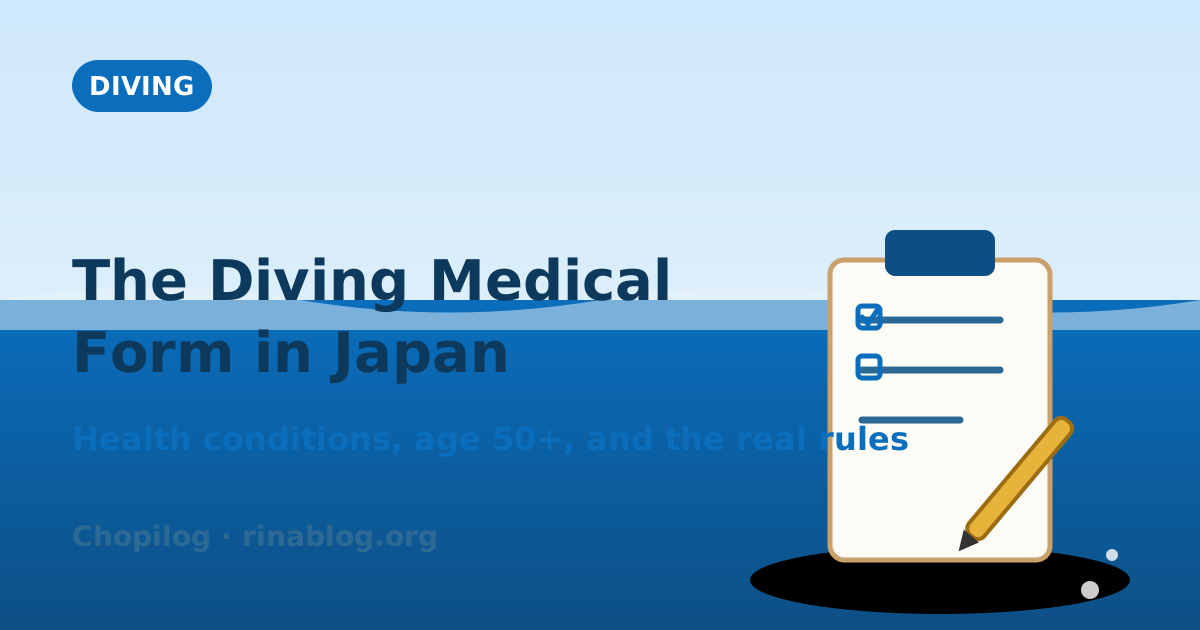
Before your first dive in Japan, long before anyone asks about your swimming ability, a dive shop will hand you a form. It asks about asthma, your heart, diabetes, epilepsy, ear surgery, and whether there's any chance you're pregnant. It isn't paperwork for its own sake, and a "yes" on it doesn't automatically mean you can't dive — but it does change what happens next, and it's a lot easier to sort out from home than from a dive shop counter the morning of your trip.
The medical questionnaire every diver fills out
The form is the RSTC Diver Medical Participant Questionnaire (checked November 2026), a standardized document used by PADI, SSI, and most other training agencies worldwide, and it's the same one used in Japan — not a Japan-specific version. Shops here commonly cite it in English for international customers; one Okinawa operator's own site, dive-in-japan.com, even tells visitors to fill it out before they arrive rather than at the counter, because "you may not be allowed to dive" without it.
If every answer is no, you sign and you're done. If you answer yes to even one question, the shop can't take you in the water on the strength of your own say-so — a licensed physician has to complete the second half of the form and sign off that they see nothing incompatible with diving. That's not the shop being difficult. It's the standard everywhere, and Japan is no exception.

Wait, so if I tick one box wrong I just... can't dive? That's scary.

It's not a closed door, it's a detour. A doctor looks at it, and most of the time that's the end of it. The only real risk is leaving it until the morning of the dive.
Bring a signed form with you — don't plan to get one here
This is the part that catches travelers out. Getting a physician's signature same-day, in English, at a clinic near your hotel is unrealistic almost anywhere, and Japan is no different. Multiple Okinawa shops that cater to foreign divers, including Honu Honu Divers and Natural Blue, direct international customers to the UHMS English-language RSTC form, print it, have your own doctor sign it before you fly, and photograph all three pages to send to the shop ahead of time. If any of the conditions below apply to you, the form is the first thing to deal with when you book — not the day before.
The conditions that trigger the physician step are consistent across agencies: asthma or other lung disease, heart conditions or high blood pressure, diabetes, epilepsy or seizures, a collapsed lung (pneumothorax) at any point in your life, and ear or sinus surgery. None of these rule you out on their own. What they do is move the decision from the dive shop's front desk to a physician who actually knows your history, which is exactly where that decision belongs.
Turning 50 changes the form, even with a clean history
One Japan-specific wrinkle worth knowing before you book: a cluster of Okinawa shops apply the RSTC age trigger strictly. Sea Sir, Honu Honu Divers, Diver's 7, and Natural Blue all independently state that anyone 50 or older gets a blood pressure check and medical screening sheet at check-in on the day, regardless of how healthy you feel. It's not a Japan-wide law, and not every shop phrases it exactly the same way, but it comes up often enough among shops that work with foreign visitors that it's worth expecting if you or someone in your group is 50+. It costs a few minutes at the counter, not a diagnosis, but it's easier to plan around if you know it's coming.
Diving while pregnant, or not sure yet
This is the one area where the guidance isn't "it depends" — it's a clear recommendation to sit this one out. DAN (Divers Alert Network, checked November 2026) advises pregnant divers to avoid diving, not because anyone has proven a specific level of risk, but because nobody can ethically run the studies that would prove it's safe. Animal research has linked diving-related nitrogen exposure to developmental problems, and DAN's own conclusion is blunt: diving during pregnancy increases risk to the fetus, and for most people it's "a completely avoidable risk." The questionnaire asks directly, including about the possibility of pregnancy, and the honest answer there matters more than anywhere else on the form.
Diving on your period
Here the answer is the opposite: there's no medical rule against it, and no official standard says otherwise. What you're managing is comfort, not safety. Cramping and low energy are worth listening to the same way you'd listen to any day you feel under the weather, and a wetsuit holds in body heat, which can make period fatigue feel worse before a long surface interval. If hygiene is a concern, a tampon or a menstrual cup works fine under a wetsuit, and it's a completely normal thing to mention to your shop if you want to ask about timing between dives. One myth worth retiring outright: menstrual blood does not attract sharks. The quantity released into open water is negligible, sharks aren't drawn to human blood in the first place, and shark researchers who've dived while menstruating report exactly nothing happens.
| Situation | What's actually required |
|---|---|
| No conditions on the list, under 50 | Sign the questionnaire yourself, nothing further |
| Turning 50 or older | Blood pressure check and screening sheet at check-in, common at Okinawa shops |
| Asthma, heart condition, diabetes, epilepsy, ear/sinus surgery, past pneumothorax | Physician's signature on the RSTC form — arrange this before you travel |
| Pregnant, or possibly pregnant | Not a form question to work around — DAN's guidance is to not dive and to talk to your doctor |
| On your period | No medical restriction; manage comfort and hygiene the way you normally would |
| Feeling off on the day (cold, hangover, jet lag) | No form for this — it's a judgment call, and skipping a dive is always allowed |
Feeling off on the day itself
None of the above covers the most common reason people shouldn't dive on a given day: jet lag, a cold caught on the plane over, or one too many drinks the night before. A blocked nose makes equalizing your ears harder and more painful, and fatigue catches up with you faster underwater than on land. There's no box for this on the questionnaire, which makes it easy to talk yourself into diving anyway because "I already paid." Don't. Every shop we've dealt with would rather reschedule a congested diver than deal with one who pushed through it, and travel insurance or a shop's own cancellation policy almost always allows for exactly this.
If your dive is near the end of your trip, the same logic applies in reverse on your way out: dissolved nitrogen needs time to clear before you fly, which is a separate planning question covered in our guide to timing dives against flights.
FAQ
Can I dive in Japan if I have asthma?
Often yes, but not automatically. The RSTC questionnaire flags asthma for physician review, and a doctor who knows your history — whether it's exercise-induced and well controlled, or more severe — makes that call, not the dive shop. Get the signed form before you travel so it isn't the thing holding up your trip.
Do dive shops in Japan have English-language medical forms?
Yes. Shops that work with foreign visitors, especially in Okinawa, commonly link to the UHMS English-language version of the same RSTC form used worldwide, and some offer it in French, Spanish, Korean, and Chinese as well. It's the identical form your home dive shop would use, so there's nothing Japan-specific to translate.
Is it true that diving is riskier on your period?
No. There's no medical restriction tied to menstruation, and the idea that it attracts sharks has no evidence behind it. The only things worth planning around are comfort — cramping, fatigue, how a wetsuit holds in heat — and whatever hygiene method you'd normally use.
None of this is medical advice, and nothing here replaces an actual conversation with your doctor and your dive shop — which is exactly the position the original Japanese version of this guide takes too. What's worth doing before you book is simple: if anything on the RSTC questionnaire applies to you, get the signed form sorted before you fly, not after you land.